
Published: August 2st, 2026 Est. |⏱️~10 minutes
By Dusty Rhoades
Maine coast decks face a unique set of challenges.
Salt-laden sea mist. A long freeze-thaw season. Frequent fog. And wet leaves that pack themselves between the boards every fall.
In this environment, one often-misread problem gets amplified fast.
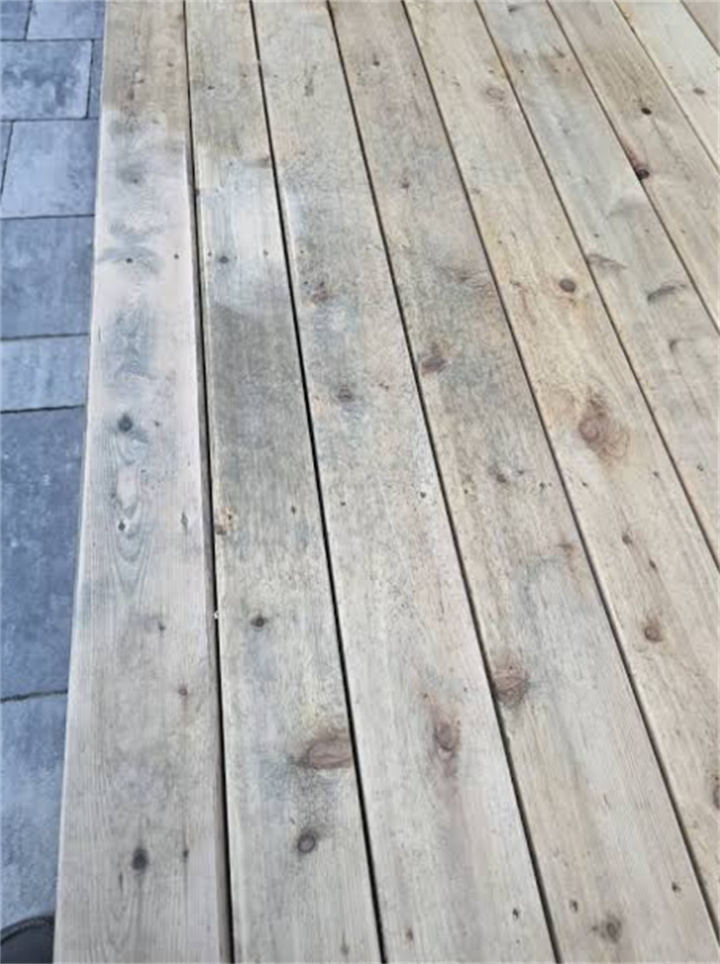
Mysterious brown water stains appear on composite (WPC) decking. Sometimes the stains run down the board edges in dark tear-like streaks. It’s easy to assume a specific product line is seriously flawed.
Yet the evidence points somewhere else.
This isn’t a trap set by a particular brand. It’s a tannin leaching process that nearly every wood-fiber composite will go through under the right climate conditions.
Tannin bleed isn’t a product defect — it’s wood fiber doing what wood fiber does
Installing composite decking across seven climate zones has forced me to sit with the tannin bleed question for a long time.
Nowhere else do homeowners point to a tissue smeared with brownish water and ask, “Is my deck bleeding?” — the way they do on Mount Desert Island or in Boothbay Harbor.
They think they got a bad batch or fell into some product-line trap.
But from what I’ve seen — building from Florida’s hurricane coast all the way up to the edge of Alaska’s permafrost — this is just wood fiber slowly releasing its natural tannins. Maine’s weather simply stretches that release out and makes it far more visible.
My first Maine install near the water was in South Portland, in a damp November.
The owner chose a dark coffee-colored board without a co-extruded cap layer. It cost just over $4 per square foot — though that’s a job-specific price, not a market average. The supplier had told him it “performs great.”
Within a month of fastening the boards, the ends facing the sea started weeping dark brown droplets.
Once dry, the stains looked like smoke smudges. The owner was sure it was a manufacturing contaminant.
I got down close. No musty smell, no rot. I scraped off the surface residue with my thumbnail — the material underneath was sound.
Then I remembered Florida. After an afternoon thunderstorm, the same brand had shown faint tea-colored water marks. But two hours of blistering sun dried it all up, and nobody noticed.
Maine offers no such privilege.
In November, mist and drizzle can keep the board surface continuously wet for days. Without a long enough dry window, the tannins get pulled out bit by bit and left to dry right on the edges.
Leaves and gaps: an overlooked staining amplifier
I later widened the deck’s board gaps from the original 3/16 inch to nearly 1/4 inch.
That was a field adjustment I made based on how that deck behaved, not something pulled from a generic installation guide.
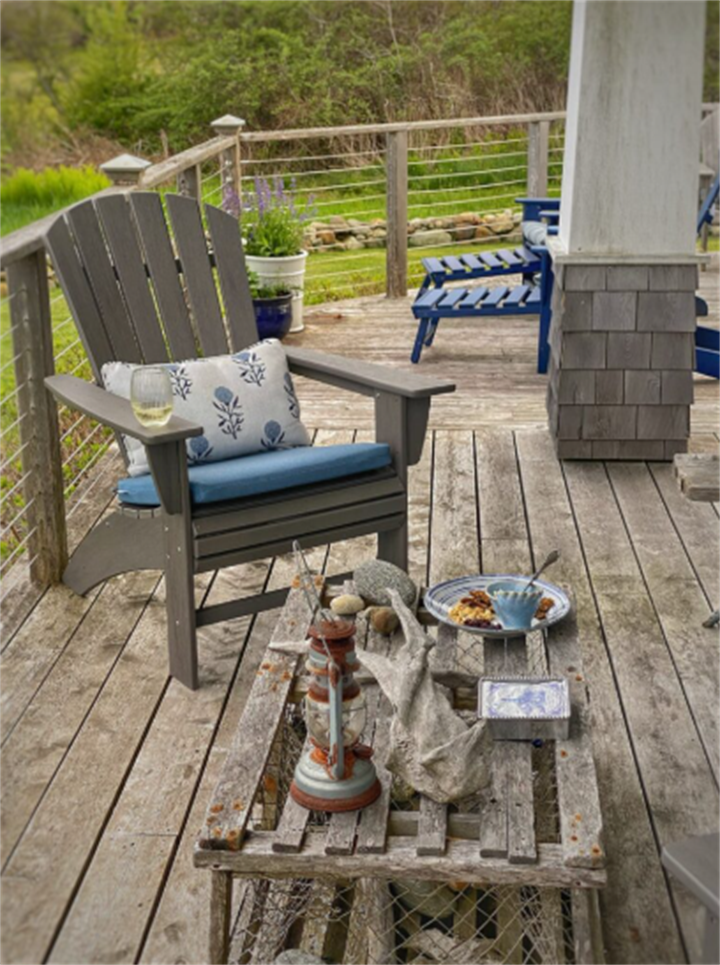
The reason? Autumn leaf drop along the Maine coast is relentless.
Red and white oak leaves are curled and stiff, and a 3/16-inch gap catches them perfectly. When rain soaks those trapped leaves, they brew their own tannin tea, which then drips down along the board seams.
I’ve seen stains directly under leaf-clogged gaps that were way darker than anything the boards themselves were releasing.
I call this the “tannin tea drip effect.” It’s not a composite line tricking anyone. It’s just plant chemistry and rainwater working together.
Sweep the wet leaves away, and the boards’ own bleed remains — but only as a light brown water stain, not something that spreads out of control.
That owner stuck it out through the winter. By the time the snowmelt season ended the following May, no fresh bleed marks were left on the deck. I told him, “Your deck has kicked its caffeine habit.”
Here’s a point I want to make clearly.
On the Maine coast, if you don’t clean fallen leaves out of the board gaps every day or two in October and November, even the most expensive capped composite can show color below the seams. I know this from repeated broom-in-hand experience, not from reading a product data sheet.
Capped composite cuts: water still finds a way in
Another case came from a hillside home near Camden.
The owner chose a grayish-white capped composite, pushing close to $7 per square foot on that job. (Again, that’s a project-specific price, so don’t take it as a universal benchmark.) The shell is pure polymer. In theory, it shouldn’t bleed at all.
But we had to cut boards on site, and every fresh end cut exposed the brown core.
After the first big snowmelt, I found faint brown rings around every cut end, almost like the board had been lightly singed. I wet my fingertip and rubbed the mark — it dissolved instantly. Water-soluble tannin, no doubt.
So even with the best capped products, if the ends of those wood fibers are exposed to sustained moisture, Maine weather will find them.
Later I treated the cut ends with the manufacturer’s recommended end-sealer. The situation improved a lot, but I won’t claim it eliminated the problem completely.
When the homeowner asked if I could promise it would never happen again, I told him: I can promise it won’t affect the structural strength. But promising zero bleed from every single cut in this environment? I can’t do that.
Tannin is a finite one-time inventory
I once made a crude but useful observation while building a cabin deck near Fairbanks, Alaska.
The summers there are extremely dry. The composite boards sat for three weeks without rain — no bleed at all. Then, in mid-August, a long, heavy storm came through. The next day, light brown water stains showed up all over the boards and ran down the surface.
I wiped some of it off with a damp cloth. Once the boards dried out completely, the same spots never bled again.
That tells me the tannins in the wood fiber are a limited stock — something that can be washed away, not a hidden defect switch buried deep inside the material.
The USDA Forest Products Laboratory’s Wood Handbook describes tannins as common polyphenolic compounds in wood that are highly soluble in water.
So this surface bleed is essentially a one-time clearance sale. Maine’s problem is that it rains so often the boards barely get a chance to dry before the next soaking arrives. That creates the illusion of a clearance sale that never ends.
A side-by-side look: capped vs. uncapped in a damp climate
I once ran a real-world comparison on a fisherman’s house near Bar Harbor.
One section got an uncapped dark chestnut board; the other got a similar color from a different brand with a co-extruded cap.
Two years later, the uncapped board ends still showed very faint tea stains during an extremely wet spring.
The capped side? No visible bleed on the board surfaces.
But I can’t simplify this to “capped equals zero tannin problems.”
Inside a few screw holes on the capped deck, I found tiny rust-colored spots. My best guess: the screws pierced the cap layer and gave moisture a pathway to the core.
This is key. On the Maine coast, it’s not just the board faces that take the weather.
Every fastener, every cut end, every screw hole is a potential tannin release point. Use an inexpensive uncapped product, and those points can link up into lines. Use a capped product, and the problem gets squeezed down to isolated spots — but it can still happen.
That’s not a trap set by any single product line. It’s a feature that every wood-fiber composite will show in a high-frequency wetting environment like this.
Where the ‘trap’ story really comes from
So why do some local builders swear that “Brand X composite is unusable in Maine — the tannin just runs forever”?
From what I’ve gathered talking to people on job sites, a lot of it traces back to a distributor who, years ago, sold a batch of high-wood-fiber, low-polymer-content uncapped boards to coastal vacation homeowners. The price got pushed down to a little over $3 per square foot, while the flyer said “mold and stain resistant.”
One winter later, those homeowners looked at decks that appeared to be splattered with coffee grounds.
They blamed the brand, and in many cases, they wrote off the whole composite category.
Strictly speaking, this wasn’t a product-line trap. It was a recipe used in the wrong climate.
The same boards might have performed passably in Texas. But Maine’s moisture and rainfall stretched out the tannin wash-out period to an unbearable length, and the leaf litter piled on to make it a public-relations disaster.
According to the 1991–2020 NOAA Climate Normals, coastal Portland averages about 47 inches of precipitation a year and more than 130 precipitation days.
That climate record is the ultimate examiner for any building material. If there’s wood fiber inside the board, this examiner will demand a tannin answer.
Cleaning and maintenance that actually works on the Maine coast
I’ve put together a set of cleaning habits refined by trial and error in Maine. You won’t find this level of detail in a generic manual.
First, never use a pressure washer above 1,500 PSI.
That’s my personal safety threshold, not a universal standard, so always check your board manufacturer’s instructions. I once helped a Rockland customer fix a deck after he blasted it with the gas-powered washer from his boat. It raised a forest of tiny fuzz on the uncapped surface. Those rough spots then became collection zones for tannin and dirt, leaving the deck looking worse than before.
Second, if noticeable brown stains have already set in, I’ve had good results spot-treating with a soft deck brush and a commercial composite cleaner that contains oxalic acid.
Most stains faded to an acceptable level within half an hour to an hour. I’ve used a product labeled “composite deck brightener” — the active ingredients were oxalic acid and some surfactants.
Always test in an inconspicuous corner first, though.
On one occasion, a cleaner left a slight whitish cast on the board. The owner said it looked like a salt-bleached patina and didn’t mind, but I wasn’t about to gamble again.
Third — and this is the cheapest, most effective move — from the moment the first red leaves fall in October until the ground freezes up in late November, keep the deck clear of any wet, matted leaves.
That soft broom beats any $50-a-gallon chemical every time. (That’s a rough comparison price, not a market average.)
Safety is not the concern; expectations are
Let me be direct: tannin bleed doesn’t weaken a composite deck’s load-carrying ability.
In every deck I’ve worked on, I’ve never seen structural failure — no breaks, no delamination, no collapse — that I could tie to tannin leaching. (This is based on my own field experience, not a controlled long-term study.)
On one Alaska deck where winter temperatures dropped to -40°F, the tannin bleed acted the same: active during the first wet season, then it faded. The boards stayed intact under frost and under the weight of a snow plow.
For Maine coast homeowners, the real decision is how much early cosmetic imperfection you’re willing to accept — and then work backward from there.
If your tolerance is low, pay the premium for a capped composite. In my experience, that’s roughly an extra $1 to $2 per square foot, though actual price gaps vary. Keep the board gaps generous. Seal every cut end. Treat fallen leaves like the enemy.
If the budget pushes you toward an uncapped board, put your effort into keeping the deck clean, and accept that the first full year will look patchy.
There is no third magic board that is simultaneously cheap, authentically wood-textured, and as non-porous as pure polymer.
In the end, you have to make peace with natural processes.
Every case of tannin bleed I’ve seen eventually stopped. Sometimes it takes as little as three months, sometimes up to a year and a half — based on my own rough tracking, not a formal study — for the washable surface tannins to exhaust themselves.
Maine coast decks will likely lean toward the longer end of that window.
But as long as there’s no standing water or rotting organic debris continuously feeding the surface, the bleeding does stop.
I often tell clients: your deck will tell its story through the first year, then fall silent in the second.
The real problem isn’t tannin. It’s slamming unrealistic expectations into the very real humidity of Maine’s shoreline.
FAQs
Q: Will tannin bleed damage the deck structure or shorten its lifespan?
A: Based on what I’ve observed in different climates, I’ve never seen a case where tannin leaching caused structural failure in a composite board. Strength depends on the polymer-to-wood-fiber ratio and the overall formulation. Surface-level washing out doesn’t reduce load capacity. Most manufacturers’ warranties also don’t list early tannin bleed as structural damage — though you should always read your specific warranty for details.
Q: Can I clean tannin stains with bleach or mildew remover?
A: I tested a sodium hypochlorite bleach on scrap cut-offs and saw mild fiber breakdown and color shift on an uncapped board. Unless the manufacturer explicitly says it’s okay, I avoid anything with chlorine. For tannin marks, a dedicated cleaner with oxalic acid and a soft brush is a safer route — but always do a compatibility test in a hidden spot first.
Q: Does capped composite eliminate tannin bleed entirely?
A: On multiple capped decks I’ve seen in Maine, the board faces themselves showed virtually no bleed. But cut ends and screw holes can still produce faint brown traces during extended wet periods. That comes from the core’s wood fibers contacting moisture through small breaches in the shell. Using an end-sealer greatly reduces it. I just can’t guarantee it will stay completely gone forever.
Q: How long does tannin bleed usually last before it stops?
A: In my experience, the main bleed phase typically finishes within 3 to 12 months after installation. In a frequently rewetted place like the Maine coast, faint residual traces might come and go into the beginning of the second wet season. After that, there’s nothing left to leach — it’s an inventory depletion process.
Q: How do I tell the difference between leaf staining and board tannin bleed?
A: If the stains concentrate right under the gaps or where wet leaves piled up, and the center of the board stays fairly clean after sweeping and rinsing, I’m confident it’s leaf tannin. Stains coming from the board itself tend to be more even, run down the board face, or give the whole board a slightly darker overall cast.
Disclaimer
This article is drawn from the author’s firsthand building experience across multiple climate zones, combined with selected publicly available technical references. It is offered for informational exchange and reference only. Actual product performance is strongly influenced by formulation, batch, installation method, and microclimate. Nothing in this article should be taken as a guarantee, endorsement, or legal recommendation regarding any specific product. Before selecting materials, building, or cleaning, always consult the latest official technical documents for the product you are using and seek advice from a local licensed contractor or structural engineer.
References
[1] Forest Products Laboratory. (2010). Wood Handbook—Wood as an Engineering Material (General Technical Report FPL-GTR-190). U.S. Department of Agriculture, Forest Service.
[2] NOAA National Centers for Environmental Information. (n.d.). 1991–2020 U.S. Climate Normals. National Oceanic and Atmospheric Administration.
About the author:
Dusty Rhoades
Builder without a fixed address. Over the past decade, he has constructed from the hurricane-prone coast of Florida all the way to the permafrost of Alaska, building outdoor facilities and providing accommodation and meals for farms, towns, and national parks. He only recommends materials that have survived a snowstorm or an entire rainy season right in front of his eyes. His advice is: "Your postal code is more authoritative than any design magazine."
Recommend:
Hot-Dip Galvanized vs. Stainless Steel Hardware for Coastal Decks: A Life-Cycle Cost Analysis
Western Red Cedar Supply in the Pacific Northwest: Why Local Small Sawmills May Beat Big-Box Stores
Are Reclaimed Bricks Safe for Outdoor Fireplaces? Reuse, Testing, and Mortar Compatibility
How to Get Sunlight to Outdoor Seats in Alaskan Winters? — Practical Strategies for Site Selection, Materials, and Wind Protection Weatherproof green outdoor lounge chair protective covers