Published: July 20, 2026| ⏱️10 minutes
By Clara M.
There’s a moment in backyard planning that can drain all your excitement. You’ve finally picked the perfect spot for the hot tub. Then you look up — and the neighbor’s second-story window stares right back at you. That uneasy feeling of being watched from above isn’t in your head. In a survey by the International Outdoor Living Space Association (IOLSA, 2025), more than 65% of people named privacy as their top priority for outdoor relaxation. It ranked ahead of budget.
But look at it another way. This hesitation is actually pushing you toward a space that’s truly yours. All you have to do now is gently block that gaze, following the sight lines you’ve mapped out.
Before You Buy Anything, Sit Down and Look Around
Before you spend a dime, do this one thing. It takes twenty minutes, and it will make every later decision feel obvious. Grab a chair that’s roughly the same height as a hot tub seat. Put it where you want the tub to go, and sit down.
Have a family member stand at that second-story window. No helper? Take a long pole, tie something bright to the top — a balloon, a strip of cloth — and hold it at window-sill height while moving slowly. From your chair, look up and note every angle where that pole appears.
Check again at dusk with the indoor lights on. When you’re in the dark looking at a lit window, the view is shockingly clear. Angles that seemed safe during the day can become completely exposed. Take a panoramic photo with your phone and circle every direction you need to block. Those red lines are where all your energy will go.
This method is so common in North American privacy design that it has a name: the “72-inch sightline rule.” An adult standing at a second-story window has eyes roughly 60 to 66 inches above the floor. The sightline starts well above 72 inches (about 1.8 meters). Meanwhile, you’re sitting in the hot tub with your eye level around 48 inches. A standard 6-foot fence simply can’t block that second-story view (Smith, 2024). Once you know that number, the “I already have a fence” illusion won’t fool you.
Drawing an Invisible Boundary with Structure
Now that you have a sightline map, it’s time to drop some obstacles into those key angles. Don’t think of it as building walls. Think of it as drawing a frame that turns “being watched” into “looking inward.”
Make Your Fence Taller — the Legal Way
In many North American neighborhoods, fences top out at 6 feet. Going higher can break local codes or HOA rules. Here’s a workaround: build a raised planter, about 12 to 16 inches tall, right against the inside of the fence. Fill it with dense evergreen shrubs. The foliage pokes above the fence line and blocks the downward angle from that second-story window.
From the outside, the fence looks the same. From your seat, the neighbor’s window disappears behind leaves. British row houses use a similar trick — adding trellis or raised beds to existing fences. Most of the time it doesn’t even need planning permission.
Add a Soft-Focus Filter Overhead
If you can stretch the budget, a pergola or cedar arbor above the tub changes everything. It doesn’t close you in; it slices the sky. Space the beams about 6 to 8 inches apart. Lying back, you’ll still see branches and clouds. From that second-story window, the view is chopped into fragments — no clear line of sight.
Japanese open-air baths often use bamboo screens or wooden lattices the same way. Light comes in. Unwanted eyes don’t.
Louvered Screens That Breathe
If the neighbor’s window faces west, you’re dealing with harsh afternoon sun and prying eyes at the same time. Water-resistant aluminum or composite wood louvered panels can solve both. Twist the slats open for morning light. Close them almost fully for instant privacy.
A 2025 test in Australia’s The Backyard Issue magazine found that louvers with 70 to 90 percent opacity cut direct visual clarity by more than 90 percent. And they do it without blocking airflow. No stuffiness, no blind spots — just the right filter.
Walls on Wheels
Renting or just don’t want to drill into the ground? A freestanding screen on casters is your answer. Use a frame of charred wood or galvanized steel, filled with translucent polycarbonate panels. Add four heavy-duty casters.
In summer, roll it to the north to let breezes through. In winter, push it against the wind. This kind of movable partition is a staple in German Schrebergärten. You can build one in an afternoon and take it with you when you move.
Grow a Living, Breathing Screen
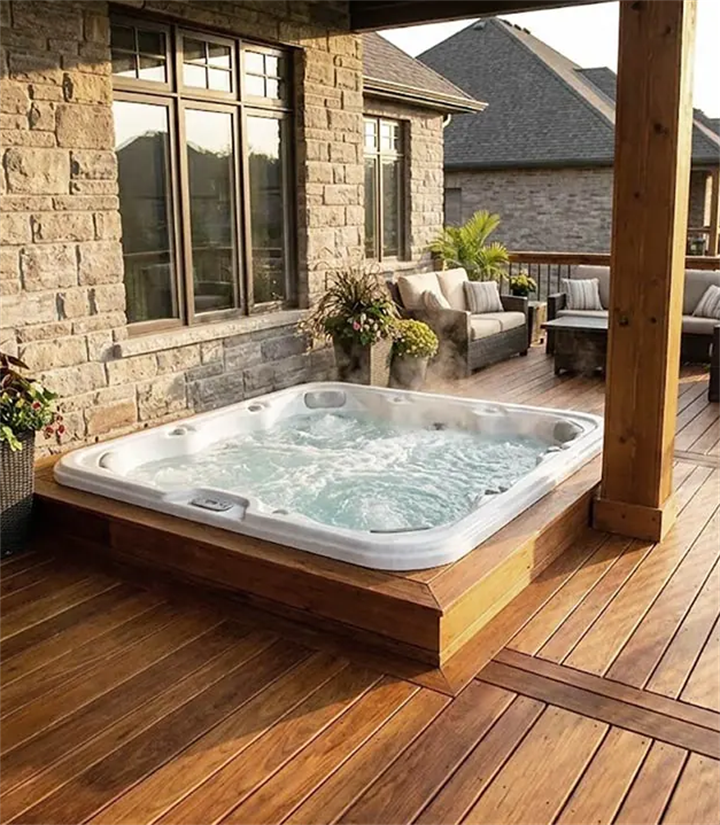
Hard structures alone can make a corner feel like a bunker. Let plants take over part of the job. They turn a boundary into something warm.
Evergreen Guards That Stand Watch All Year
Hollies like ‘Nellie Stevens’, feijoa, or Portuguese laurel grow 10 to 13 feet tall and keep their leaves all winter. They’re dense enough to block a view completely. The American Society of Landscape Architects (ASLA, 2024) also highlights Fargesia rufa, a clumping bamboo that reaches about 10 feet. It’s non-invasive, grows well in large pots, and its tight canes rustle in the wind without blocking the sky — yet it stops downward glances perfectly. It thrives in temperate zones across North America and Europe.
Go Vertical When Ground Space Is Tight
Short on ground space? Go up. Attach a heavy-duty trellis to the fence and plant evergreen clematis (Clematis armandii) or star jasmine. In a single season, the leaves form a living wall that barely thins in winter.
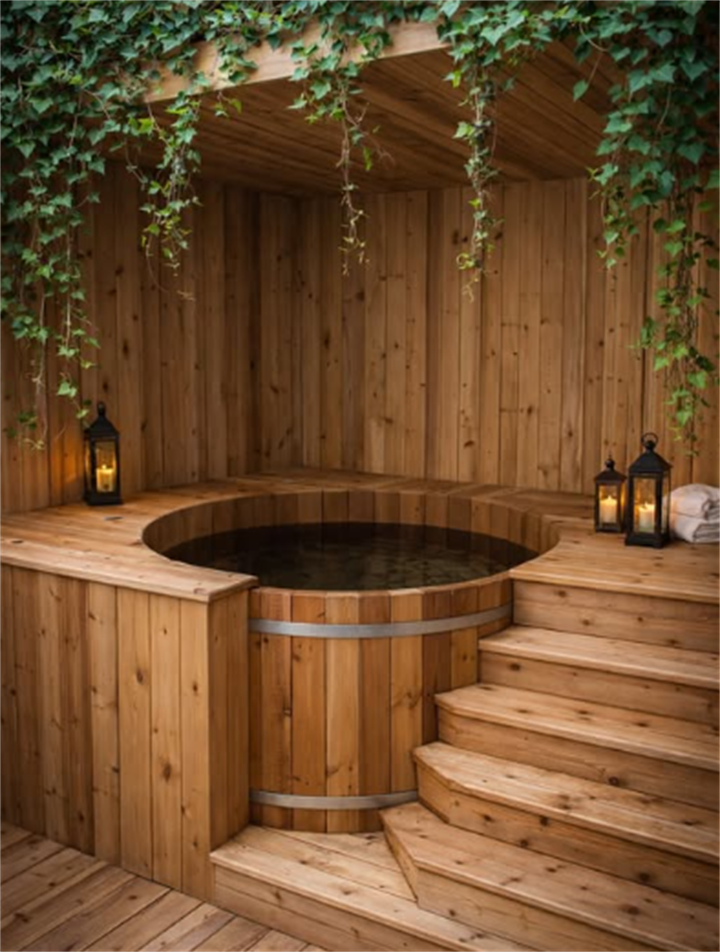
Another idea: hang pots of ferns or ivy from your pergola beams. The trailing stems create a semi-sheer curtain. From above, the water is hidden. But dappled light still lands on your shoulders.
Potted Giants You Can Move Around
Grab a few large pots — at least 24 inches across — and plant a 6-foot cedar or lemon-scented gum. Push them right into the sightline between your seat and that window. Settle into the tub and adjust the pot’s position until the window vanishes behind shifting leaves.
New Zealand beach houses often pull off this trick with oversized agaves and flaxes. It’s inexpensive and looks like it’s been there forever.
Get the Light and Sound Right, and Your Body Follows
You’ve blocked the view. But sound and light can still betray your sense of seclusion. A neighbor might not see you clearly, but if your conversation or the hum of the tub carries, privacy still leaks away.
Let Water Drown Out the World
Place a small recirculating water feature near the tub — a simple urn or stone basin with a short drop of 8 to 12 inches. That gentle trickle creates a curtain of white noise. A Canadian study (Brown & Patel, 2025) found that natural water sounds around 55 decibels significantly boost perceived privacy. They don’t make conversation difficult, either.
Don’t want to run power? A floating solar fountain does the same job. It costs a few dozen dollars and gives you both sound and a little water dance.
Aim Lights Down and Keep Them Warm
Flooding your tub area with bright light turns you into a glowing target. Instead, use warm-white LED strips (2700K) tucked under step lips, inside planter bases, and along bench edges. The light should graze the ground, not blast upward.
Add low-glare in-ground lights to mark the path safely without shooting light into the sky. From that second story, your corner will read as nothing more than a soft amber glow at the far end of the yard.
Sometimes a Shift in Layout Does More Than Any Structure
A clever layout often saves more money than any amount of added material.
Tuck Yourself Into a Corner
Push the hot tub into the L-shaped corner where your house meets the fence. Two solid walls already work for you. On the open sides, add a semi-fixed screen on one and a row of tall potted plants on the other.
Sitting there, you’re wrapped on three sides with a canopy of branches or a pergola overhead. Your body reads it as a cocoon. That’s the same logic behind the tucked-away courtyards in Kyoto’s old townhouses — and it works just as well in a suburban backyard in Ohio or Surrey.
Draw the Floor
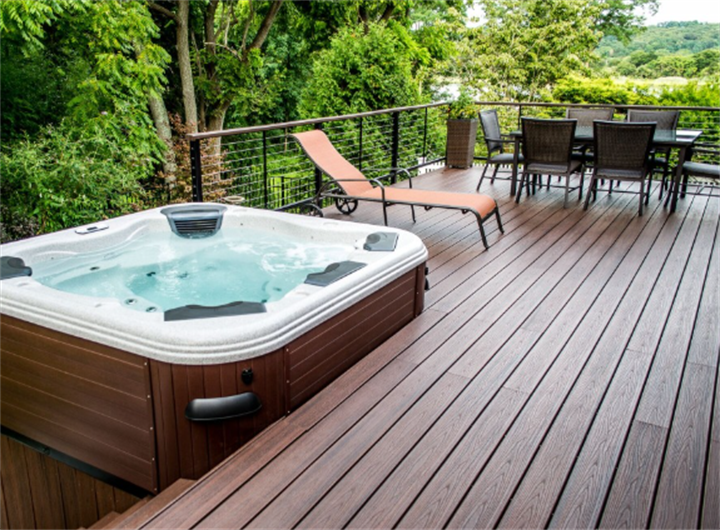
Define the hot tub zone by changing the flooring. Use slip-resistant composite decking or warm stone, and raise it just 4 to 6 inches above the surrounding patio. Edge it with a gravel drainage strip.
The moment your foot hits that new surface, your brain registers: this place is different. It’s yours.
One-Touch Ease
For those who want privacy without the hassle, install motorized privacy screens or a sliding shade sail. Some manufacturers in the Netherlands and Germany now offer integrated outdoor spa enclosures. Press a remote, and panels rise and tilt slightly to block the view, cut the wind, and trap heat. That effortless switch is its own kind of therapy.
Two Things to Do Before You Break Ground
First, check your local zoning code. In North America, fence heights, setbacks, and whether a pergola needs a permit vary wildly. If you have an HOA, even colors and materials might need approval. In the UK, look up permitted development rules — especially if a structure is within two meters of a boundary. Australia’s rules change from state to state; what’s fine in Victoria might not fly in Queensland. Read the rules before you dig.
Second, talk to your neighbor. Mention you’re creating a quiet spa corner with some plants and screens. When you bring it up first, people tend to be more mindful of their own windows. Most disputes aren’t really about a line of sight. They’re about the nagging worry that someone might be watching. Name it, and the tension often fades.
A backyard overlooked by a second story isn’t a flaw. It’s a nudge to add one more layer. When dense foliage and wooden slats turn the neighbor’s window into a blur of light, when the murmur of water drowns out distant traffic, and the glow is just bright enough to see steam curling in the air — that corner stops being a hiding spot. It becomes a small sanctuary, woven by your own hands.
FAQs
Won’t a fully enclosed space feel claustrophobic?
Not if you use see-through-but-not-see-through materials — lattice, plants, semi-transparent panels. Keep the sky visible overhead. When the enclosure is made of gaps rather than solid walls, the space actually feels more secure, not less. Think of it like a tent: cozy, not cramped.
What’s the most cost-effective way to start on a tight budget?
Build a DIY wooden screen on casters and stretch UV-resistant canvas across it. Add two or three large potted evergreens. No foundations, no contractors — one weekend. Drop a floating solar fountain in the tub for instant white noise. All in for well under a couple hundred dollars.
How long until plants actually block the view?
Fast annual climbers like morning glory or hops can cover a trellis in one season, giving you a quick green curtain. At the same time, use mature evergreens in pots for immediate coverage. You’re building both the now and the later.
Do I really have to talk to my neighbor?
It’s not just polite — it’s protective. When you mention you’re adding privacy screens for a quiet corner, most people respond well. Some will even start pulling their blinds at certain times. People are often more reasonable than we fear, as long as we offer honesty first.
Disclaimer
This article is for general informational purposes only and does not constitute professional legal, architectural, or engineering advice. Building codes, permit requirements, and HOA rules vary significantly by country and region. Always consult a licensed professional before starting any project. The plant species mentioned are suitable for many temperate and some subtropical climates; choose according to your local conditions.
References
[1] American Society of Landscape Architects (ASLA). (n.d.). Residential landscape design resources and sustainable site design. https://www.asla.org/
[2] International Code Council (ICC). (2021). 2021 International Residential Code (IRC). International Code Council.
[3] North American Deck and Railing Association (NADRA). (n.d.). Deck Safety and Outdoor Living Resources. https://www.nadra.org/
[4] U.S. Environmental Protection Agency (EPA). (n.d.). Soak Up the Rain: Rain Gardens. https://www.epa.gov/soakuptherain
[5] University of Maryland Extension. (n.d.). Native Plants and Landscaping. https://extension.umd.edu/
Author Information:
Clara M.
A landscape architect, a mother of three children, now specializes in diagnosing "Why can't people stay in the yard?" Her designs do not aim for being photogenic; they only care about whether you would be willing to spend an extra ten minutes sitting in the evening. She believes that a truly functional backyard will make you forget your phone but remember the wind and the tree shadows of that day.
Recommend:
Hot-Dip Galvanized vs. Stainless Steel Hardware for Coastal Decks: A Life-Cycle Cost Analysis
In a Backyard Under 1,000 Square Feet, Create Three Separate Zones for Different Ages

The Hidden Soft Costs of Outdoor Projects: Design, Permits, and Surveying
Creating a Backyard Oasis in Phoenix That Won’t Burn Your Feet – A Material Guide