Published: July 30, 2026|⏱️12 minutes
By Tommy "The Tally" Kowalski
The upfront price per square foot rarely tells the whole story. Sealing costs money. Repairs cost money. And when performance degrades over time, that costs money too. These expenses almost never show up on the initial quote. Three to five years after installation, the bills start arriving – and it’s not unusual for the total to exceed the original budget by 30% or more.
Soapstone, granite, and concrete are the three most common choices for outdoor kitchens and entertaining areas. Before you decide, there are three key questions to answer: How resistant is each material to stains? How likely is it to crack? And what will it really cost to maintain over the long haul? This article walks through each of those angles, one by one.
We’ve drawn on ASTM testing standards, the Natural Stone Institute’s Dimension Stone Design Manual, and publicly available product data from major suppliers. The price ranges reflect the North American market as of 2025–2026. Your local numbers will vary – but the relative differences between the materials should hold up.
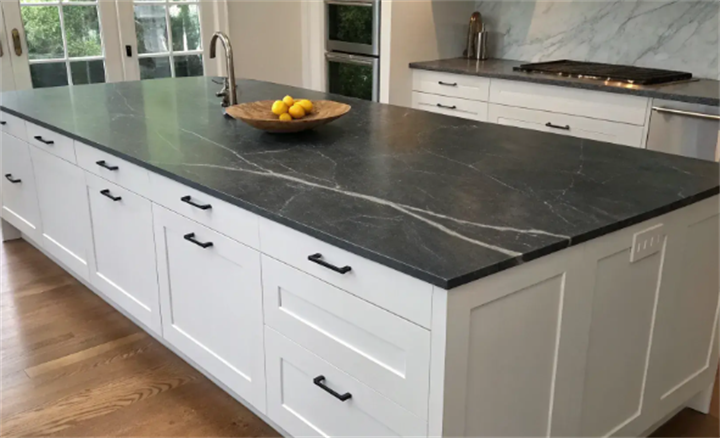
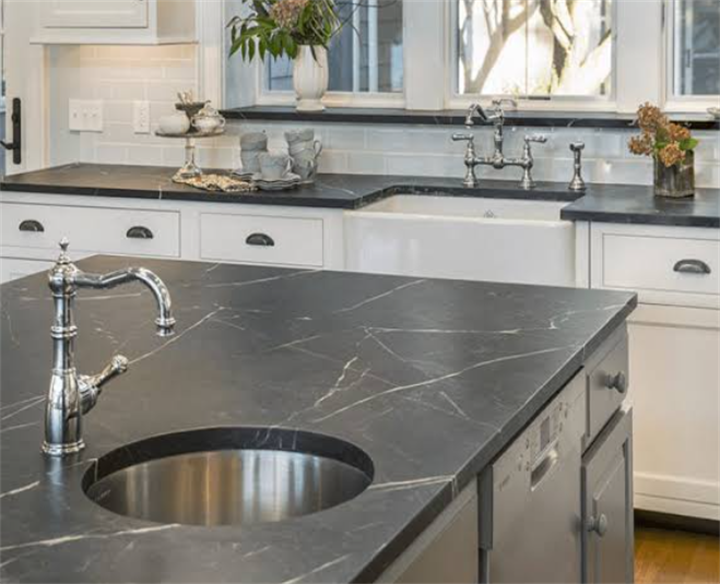
Soapstone: Great stain resistance, but you’ll have to live with “soft”
Soapstone’s biggest advantage is its very low porosity. ASTM C97 tests show water absorption typically falls between 0.1% and 0.4% for different soapstone samples. Some commercial grades – like Alberene Soapstone – test as low as 0.04% or even 0.02%. That means oils, wine, and sauces have a hard time penetrating the surface. In most cases, they just sit on top and wipe right off.
That said, “completely stain-proof” is a bit too absolute. Soapstone from different quarries has different talc content and density. In rare cases – if a spill sits for a very long time or the stone is lower quality – you might see a mark. Still, compared to granite and concrete, the risk is substantially lower.
The trade-off is hardness. Countertop-grade soapstone ranks around 3 to 4 on the Mohs scale (some sources give 2.5 to 3.5). For context, granite is 6 to 7, and common stainless steel is about 5.5. So a metal utensil can leave a scratch on soapstone fairly easily.
But scratches are easy to fix. Light ones can be blended in with a little mineral oil. Deeper ones can be sanded with fine grit (220 or higher) and then re-oiled. A bottle of mineral oil costs about $10 at any hardware store.
Soapstone also handles heat well. Its low thermal expansion means you can set a hot pan directly on it without cracking. Freeze-thaw performance is good too, thanks to that low absorption. However, detailed test data for extreme temperature cycles is limited in public sources, and performance can vary by quality grade.
Material price: roughly $75 to $150 per square foot – the highest of the three upfront. But long-term maintenance costs are minimal, mostly just oil and sandpaper.
Granite: Reliable and predictable, but sealing is a recurring expense
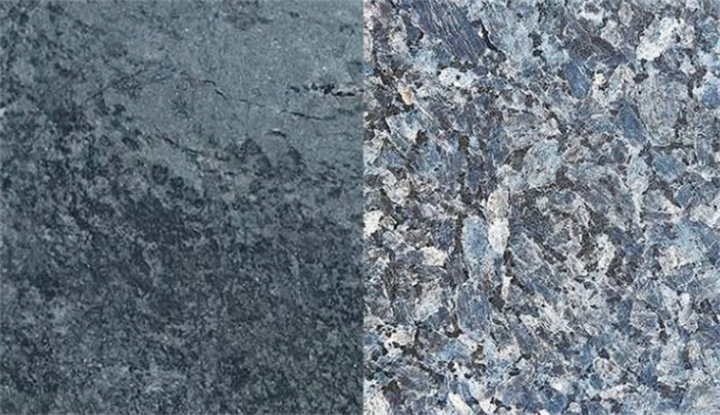
Granite is the most documented and consistent of the three. Its Mohs hardness of 6 to 7 makes it very resistant to scratches in daily use. Water absorption varies by type – typically 0.1% to 0.6%. Some dense dark granites can go below 0.05%, while lighter or more weathered ones may exceed 0.5%.
Granite needs sealing – that’s a given in the industry. How often? It depends on your climate and how heavily you use the countertop. In moderate conditions, every 2 to 3 years is common. In areas with strong UV, big temperature swings, or acid rain, you may need to check annually. A simple water-drop test works: put a few drops on an inconspicuous spot. If the water doesn’t bead up or gets absorbed within 10-15 minutes, it’s time to reseal.
There’s no such thing as “permanent sealing” – every penetrating sealer (silicon-based, silane, or fluoropolymer) degrades over time from UV exposure, temperature changes, and normal wear.
Granite is also sensitive to thermal shock. The exact thermal expansion coefficient depends on its mineral makeup (quartz, feldspar, mica ratios), but dropping a very hot object onto a cold slab can cause micro-cracks – or even visible ones. Use a trivet or heat pad. It’s cheap insurance.
Granite prices range widely – about $50 to $150 per square foot depending on origin, grade, and fabrication. Professional sealing runs $400 to $1,200 per visit in North America, based on size and local labor rates. If you do it yourself, a bottle of quality sealer costs about $40 to $60.
Concrete: Maximum design flexibility, with the highest maintenance burden
Concrete’s big draw is its versatility – you can cast any shape, color, or texture. But that flexibility comes with significant upkeep.
Concrete is naturally porous. Exact porosity varies wildly with the mix design, water-to-cement ratio, aggregate, and curing – there’s no single industry standard. All concrete countertops need sealing to resist staining. Outdoors, UV rays break down sealers faster, so maintenance intervals are shorter than indoors. Some concrete guides recommend re-waxing or reapplying a protectant every 3 to 4 months. Even with regular care, you should wipe up water, acidic spills (lemon juice, vinegar), and anything that might stain (red wine, grease) promptly to avoid permanent marks.
Cracking is another concern. Causes include drying shrinkage, thermal cycling, uneven settling of the base, or poor support for overhangs. Adding steel or glass fibers, controlling the water-to-cement ratio, and proper moist-curing (at least 7 days, ideally 28) all help reduce risk. But systematic data on outdoor concrete countertop failures in freeze-thaw climates isn’t publicly available, and results vary enormously with the installer’s skill.
Custom concrete countertops run about $65 to $135 per square foot, but complexity, color, reinforcement, and finish can push that higher. Over a decade, frequent sealing and potential repairs mean the total cost is likely higher than soapstone or granite.
10-Year total cost comparison (30 sq. ft. example)
These are ballpark figures based on 2025-2026 North American averages. Your local numbers will differ – treat these as relative guides, not firm quotes.
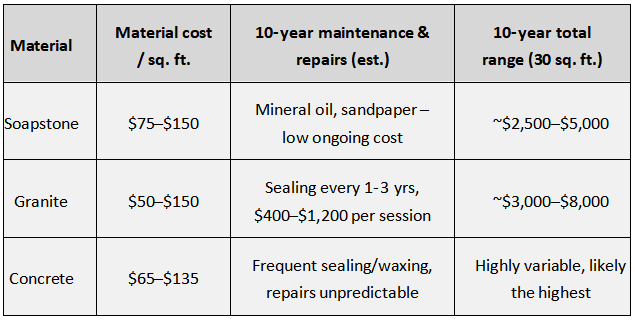
Soapstone has the highest upfront cost but the lowest maintenance spend. Granite has the cheapest entry point but steady sealing bills add up. Concrete sits in the middle on price but carries the most uncertainty in long-term expenses.
Which one should you choose?
Think about what you can live with.
Pick soapstone if you’re okay with scratches and want minimal ongoing work. Scratches are easy to sand and oil.
Pick granite if you value proven performance and don’t mind resealing every 1-3 years. And always use a heat pad.
Pick concrete if you really want a custom look and are willing to accept higher maintenance and some cracking risk. Get the warranty and reinforcement details in writing before you sign.
FAQ
Q: Is soapstone really completely stain-proof?
A: Its absorption is very low – around 0.1% per ASTM C97 – so it resists stains well. But “completely” is too strong. Different stones vary. Darkening from moisture is usually temporary and fades when dry.
Q: Can I seal granite myself?
A: Yes. Penetrating sealers cost about $40-$60 at hardware stores. For the first application, it’s worth having a pro do it to ensure even coverage. After that, DIY is fine. Use the water-drop test to decide when it’s time.
Q: If a concrete countertop cracks, is it ruined?
A: Not necessarily. Small surface shrinkage cracks can be filled with repair compound. But structural cracks – especially with uneven edges – need professional repair, and results vary. Costs can mount quickly.
Q: Is there any outdoor countertop material that needs zero maintenance?
A: No. Every material reacts to UV, temperature swings, and daily wear. The difference is only in the type and frequency of care required.
Disclaimer
This article is based on the author’s fifteen years of estimating experience, along with publicly available standards, industry manuals, and market data. It is intended for homeowners and DIY enthusiasts as a reference only. Actual performance depends on specific batch quality, installation methods, local climate, and usage habits. All prices are typical North American estimates and do not constitute a quote for any particular project. Always consult a local licensed contractor and assess site conditions before making final purchasing and installation decisions.
References
[1] ASTM C97 – Standard Test Methods for Absorption and Bulk Specific Gravity of Dimension Stone
[2] Natural Stone Institute. (2024). Dimension Stone Design Manual
[3] Alberene Soapstone – product technical data sheets
[4] Various granite supplier product specifications
[5] Concrete countertop industry maintenance guides
About the author:
Tommy “The Tally” Kowalski
Having worked as a contractor estimator for fifteen years, now he does only one thing: exposing the tricks in the building materials quotations. He doesn't speak politely, but every word is aimed at saving you money. His creed is: "All those seemingly too-good-to-be-true unit prices actually hide hidden fees that are deliberately not written down."
Recommend:
Soapstone vs. Granite vs. Concrete for Outdoor Countertops: Stains, Cracks, and 10-Year Ownership Costs
The Vanishing "Room" in Open-Plan Homes: A Bug-Proof, Breezy Screened Dining Porch
Why Your Patio Feels Like a Hallway: Break the Linear Space with Diagonal Decking
How to Build an Outdoor Kitchen on a Slope: Retaining Walls That Create Stable Spaces for Cooking and Gathering