Published: July 31, 2026|⏱️10 minutes
By Tommy "The Tally" Kowalski
In the world of construction quotes, the most expensive line items are often the long-term costs that never make it into the initial budget. This guide breaks down the full 25-year cost of so-called Brazilian Teak — which is almost always Cumaru — versus high-quality composite decking. You won’t find marketing fluff here. Every judgment is built on available market data and real-world building experience. The goal is to help you make a clear-headed decision that fits your own situation.
1. Know your material: what “Brazilian Teak” actually is
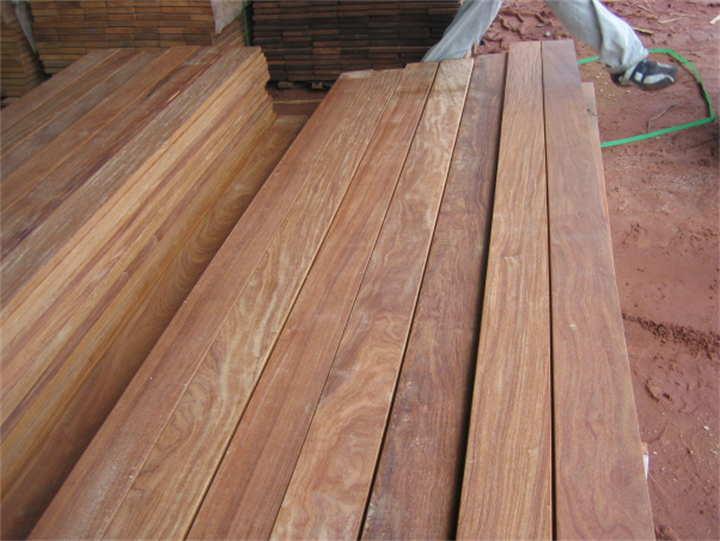
Before we talk money, we need to be sure we’re talking about the same thing. Most decking sold as Brazilian Teak is not true Teak. It is a South American hardwood called Cumaru, or sometimes its close relative Ipe.
Both woods are extremely dense. They contain natural oils that give them strong resistance to rot, insects, and warping. Compared to genuine Burmese Teak, Cumaru and Ipe are typically harder and nearly as durable, yet they cost considerably less. That makes them popular substitutes for outdoor decks.
Because every cost projection that follows depends on the exceptional longevity of these hardwoods, getting the name right from the start helps you avoid expensive mix-ups.
2. Upfront installation cost: what you pay on day one
Labor rates and material supply vary widely by region. The figures below are drawn from publicly reported costs in North America and Southeast Asia. They show the relative price gap between the two materials, not a universal price tag.
Brazilian Teak (Cumaru / Ipe)
According to aggregated installation cost data from platforms like HomeAdvisor, a complete Ipe deck — including decking boards, substructure, labor, and basic fasteners — generally runs between $25 and $45 per square foot. Cumaru tends to sit at the lower end of that range, though it rarely dips below $20 per square foot. In Singapore, similar tropical hardwood decks average S$20 to S$35 per square foot installed. For a typical 400-square-foot deck, the initial outlay can easily exceed $10,000.
Composite decking (WPC)
High-quality capped composite decking — where a protective polymer shell is co-extruded around the board — comes in a broad range, typically $15 to $36 per square foot installed. That is already more expensive than ordinary pressure-treated lumber, but still about 30% to 50% cheaper than tropical hardwood in terms of initial cost. On the same 400-square-foot deck, choosing composite can save you several thousand dollars right away.
That difference is tempting. But the purchase price only tells the first part of the story. The real gap opens up when you look at what happens over time.
3. Service life: how long before the deck needs to be replaced
This is the single most powerful variable in a life-cycle cost comparison. How often a material forces you to rebuild usually matters more than its unit price.
Brazilian Teak
With a properly designed substructure that allows ventilation and drainage, Cumaru can remain structurally sound for over 30 years — even without any protective coating. Ipe has been documented to last 75 to 100 years in outdoor applications. In most residential scenarios, a well-built tropical hardwood deck is likely to outlast your time in the home. A common rule of thumb among builders is that premium hardwood decks last three to four times longer than standard composite ones.
Composite decking
Service life here is tightly linked to product quality. First-generation composites without a protective cap often started to fade, crack, or absorb moisture within 7 to 10 years. Today’s mainstream capped composites typically carry a life expectancy of 15 to 20 years under normal conditions, with some high-end lines claiming 25 years or more. Field data and repair records, however, suggest that a significant share of composite decks show enough surface aging by year 20 that owners choose to replace them — even if the structural core hasn’t fully failed.
For a 25-year analysis, it is therefore a realistic and cautious assumption that Brazilian Teak will need zero structural replacement, while a quality composite deck is likely to require one complete renovation within that window.
4. Maintenance cost: steady upkeep versus near-zero care
What you spend year after year — or don’t spend — becomes a surprisingly large number when you extend the timeline to two and a half decades.
The maintenance profile of Brazilian Teak
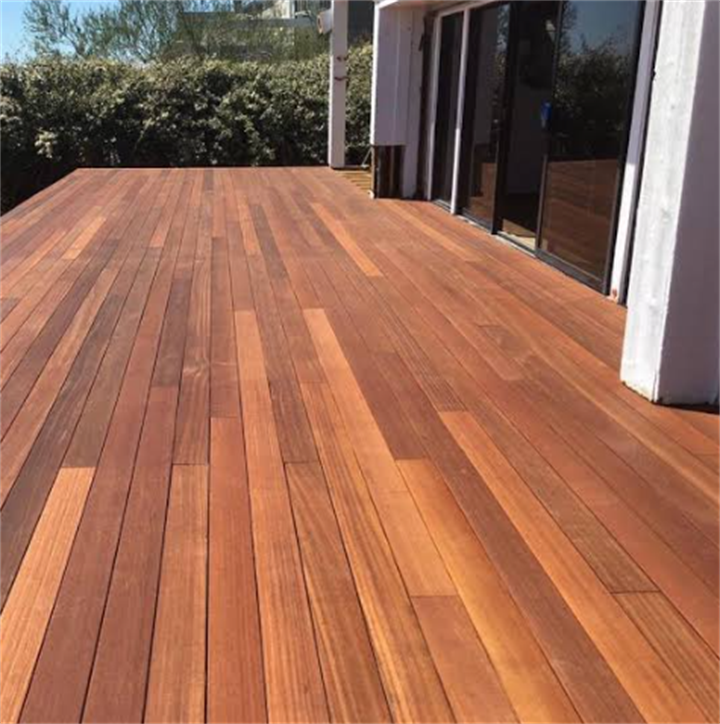
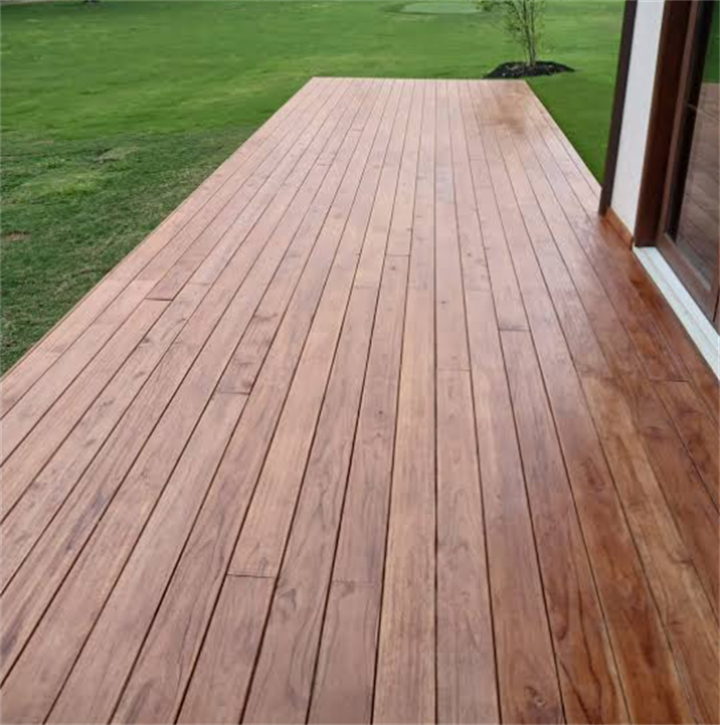
The natural oils in Cumaru don’t last forever. After one to two years of sun and rain, the surface oils begin to break down. The wood itself does not rot, but its color shifts from a warm brown to an even silvery gray. If you want to keep the original tone, you need to clean the deck and apply a penetrating oil or sealer every year or two.
North American maintenance cost surveys indicate that for hardwood decks that are regularly maintained, cumulative upkeep over 15 years averages roughly $0.80 to $1.20 per square foot. For a medium-sized deck, that can mean several thousand dollars in total. Some homeowners choose to do the work themselves to save on labor, but the specialized oils and cleaners are still a fixed expense.
The maintenance profile of composite decking
One of the main selling points of capped composite is extremely simple care. It requires no oiling, staining, or sealing. Ordinary dirt usually comes off with a garden hose or a soft brush. In damp, shaded settings, an occasional mild anti-mold wash may be needed, but overall spending is minimal. Industry reports put the total 10-year maintenance cost for a comparably sized composite deck at roughly $200 to $500. Over 25 years, this line item barely registers.
In essence, Brazilian Teak asks you to invest some time and money every year or two to preserve its appearance and surface protection. Composite eliminates that annual ritual, at the expense of a fixed lifespan that is substantially shorter.
5. 25-year life-cycle cost simulation: one clear picture
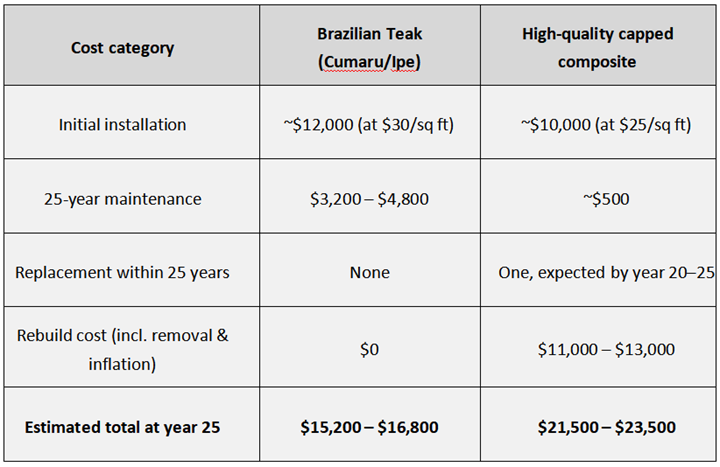
To make the long-term economics visible, let’s model a 400-square-foot deck using market midpoints. The composite replacement is assumed to happen between year 20 and 25. All figures are estimates in USD, based on aggregated data from HomeAdvisor, NADRA, and industry reports.
A few patterns stand out:
In the first 10 to 15 years, composite is clearly cheaper in total out-of-pocket cost. The initial price is lower and maintenance is almost nothing.
By around year 15, the ongoing maintenance expense of hardwood begins to narrow that gap.
The real turning point arrives between year 20 and 25. Composite faces its first full replacement — a bill that, with labor inflation and tear-off costs, is likely equal to or higher than the original installation. Meanwhile, the hardwood deck is still structurally intact and only needs its regular coat of oil.
By the quarter-century mark, the seemingly cheaper composite path may actually end up costing several thousand dollars more.
Extend the timeline to 50 years, and the difference becomes even more pronounced. Composite may need two or three replacements, multiplying the initial investment several times over. Brazilian Teak, by contrast, largely just continues its routine of periodic care.
The practical takeaway is this: if you expect to be in the same home for roughly 10 years or less, composite offers clear short-term savings. If you view the house as a long-term or permanent home, Brazilian Teak’s “build once and maintain” nature is more likely to work in your financial favor over the decades.
6. Comfort, safety, and everyday experience
Cost is not the only factor. How a deck feels underfoot and how it behaves in extreme weather can be deal-breakers.
Surface temperature
Tropical hardwoods conduct heat slowly. Even after hours of direct sun, they usually stay relatively cool to the touch. Composite, under the same exposure, can reach 140°F (60°C) or higher. For families who like to walk barefoot, or for pets, the risk of discomfort and burns is real.
Fire rating
The natural density of hardwoods like Ipe allows them to achieve a Class A fire rating — the highest level. In regions prone to wildfires, or where local building codes are strict, this can be a non-negotiable requirement. Most composites carry a Class B or C rating. If your insurance or local inspector demands Class A, your material decision may be made for you.
Look and feel over time
After a few years, Cumaru grain stays crisp and the color deepens into a rich, lived-in brown. Composite can look remarkably wood-like when new, but with long-term exposure, some products develop a faint plastic sheen or uneven fading that is difficult to reverse — especially on lighter colors.
Environmental notes
Brazilian Teak from responsibly managed forests — look for FSC certification — locks carbon for decades and can be a long-cycle renewable material. Composite uses recycled plastics and wood fibers, which gives waste material a second life. However, because the mixed materials are hard to separate, most composite ends up in landfills at the end of its service life.
7. How to decide for your own project
There is no universal “winner.” The better choice depends on how long you plan to stay and how you weigh upfront cost against long-term responsibilities.
Brazilian Teak may be the better fit when:
You are in a long-term home, likely 20 years or more.
You are comfortable doing (or paying for) a simple cleaning and oiling routine every year or two.
You value the natural warmth and grain of real wood, including how it gracefully shifts color with age.
Local codes or insurance policies demand a Class A fire rating.
You think in terms of total cost over decades, not just the lowest upfront price.
Composite may be the better fit when:
You expect to move within 10 to 15 years.
You want near-zero maintenance — no seasonal oiling, no scrubbing beyond an occasional rinse.
You live in an area with extreme humidity or high termite pressure (composite is immune to both).
Your initial budget cannot stretch to the higher first cost of hardwood.
You prioritize week-to-week convenience over long-term material economics.
This is not about one material being “bad” and the other “good.” It is about matching the material’s cost profile to your own timeline, maintenance tolerance, and budget structure.
When you start collecting quotes, ask suppliers to clearly state: the exact species or product line, any certifications (such as FSC), a breakdown of installation and labor charges, and recommended care. Compare at least three written estimates before making a final call.
FAQs
Will Brazilian Teak rot if I don’t oil it?
No. Skipping oil mainly affects the color. The wood turns a silvery gray as it weathers, which is a natural surface change, not structural damage. If you like that look, you can simply clean the deck and dramatically reduce your maintenance costs. The deck’s service life stays nearly the same.
Why does this analysis assume composite needs replacing within 25 years?
Many products advertise a 25- to 30-year lifespan, but those figures often come from ideal lab conditions. Real-world feedback and repair records show that a noticeable share of decks begin to show significant surface aging by year 20, leading owners to replace them within the 25-year window. Including one replacement is a conservative but practical planning assumption.
Does the conclusion change for smaller or larger decks?
Changing the size affects the labor cost per square foot, but the relative cost ratio between the two materials remains fairly stable. With a smaller deck, the total maintenance dollars for hardwood are lower in absolute terms, so its long-term cost advantage can appear even earlier.
Can I just let my hardwood deck go gray and skip the maintenance?
Yes. If you accept the weathered gray appearance from the start, there is no need to oil it to keep the original color. In that case, the maintenance cost of Brazilian Teak drops significantly, and its long-term value becomes even more compelling.
Does composite really require no maintenance at all?
For the most part, a rinse with water is all you need. In shaded, damp spots, you might apply a mild mold cleaner once a year. The cost and time involved are minimal.
Disclaimer
The cost ranges and lifespan estimates in this article are drawn from publicly available installation platforms, industry technical bulletins, and long-term user feedback, primarily reflecting North American and selected Southeast Asian markets. Actual prices in your area may differ due to local labor rates, shipping costs, deck complexity, and regulatory requirements. All calculations are comparative estimates and do not represent a guaranteed quote for any specific project. Before purchasing, you are strongly advised to obtain detailed written quotes from at least three licensed local contractors and to verify product specifications, certifications, and warranty terms. The author has no financial affiliation with any material brand, manufacturer, or distributor mentioned.
References
[1] North American Deck and Railing Association. (2025). Deck material lifespan and maintenance cost estimates. NADRA Consumer Resource Series.
[2] Singapore Building and Construction Authority. (2025). Comparative cost data for outdoor decking. BCA Technical Resources.
[3] Rainforest Alliance. (2024). Durability and performance of tropical hardwood decking. Sustainable Forestry Technical Notes.
[4] WPC Council. (2026). Wood-plastic composite decking: durability, maintenance, and replacement trends. WPC Council Industry Overview.
[5] U.S. Consumer Product Safety Commission. (n.d.). Surface temperature measurements on residential deck materials. CPSC Research Database.
About the author:
Tommy “The Tally” Kowalski
Having worked as a contractor estimator for fifteen years, now he does only one thing: exposing the tricks in the building materials quotations. He doesn't speak politely, but every word is aimed at saving you money. His creed is: "All those seemingly too-good-to-be-true unit prices actually hide hidden fees that are deliberately not written down."
Recommend:
Outdoor Kitchen Stucco Finishes: Smooth vs. Exposed Aggregate—The Real Cost Breakdown Before You Build
Maine Coast Decks: Avoiding the ‘Tannin Bleed’ Trap with Specific Composite Lines
In a Backyard Under 1,000 Square Feet, Create Three Separate Zones for Different Ages
How to Build an Outdoor Kitchen on a Slope: Retaining Walls That Create Stable Spaces for Cooking and Gathering